Bitcoin Wallet Investigator
Investigate a Bitcoin wallet in one run: a risk level you can explain, the funds traced to where they went and where they came from, and a report ready for the case file.
From a manual review to a single run
Reviewing a suspicious wallet usually means hours in a block explorer and a spreadsheet: reading its transactions, following the money from one wallet to the next, and writing it all up for the file.
The Bitcoin Wallet Investigator does this in one run and documents it the same way every time, while your team keeps control of the rules and of the decision.
A risk level you can explain
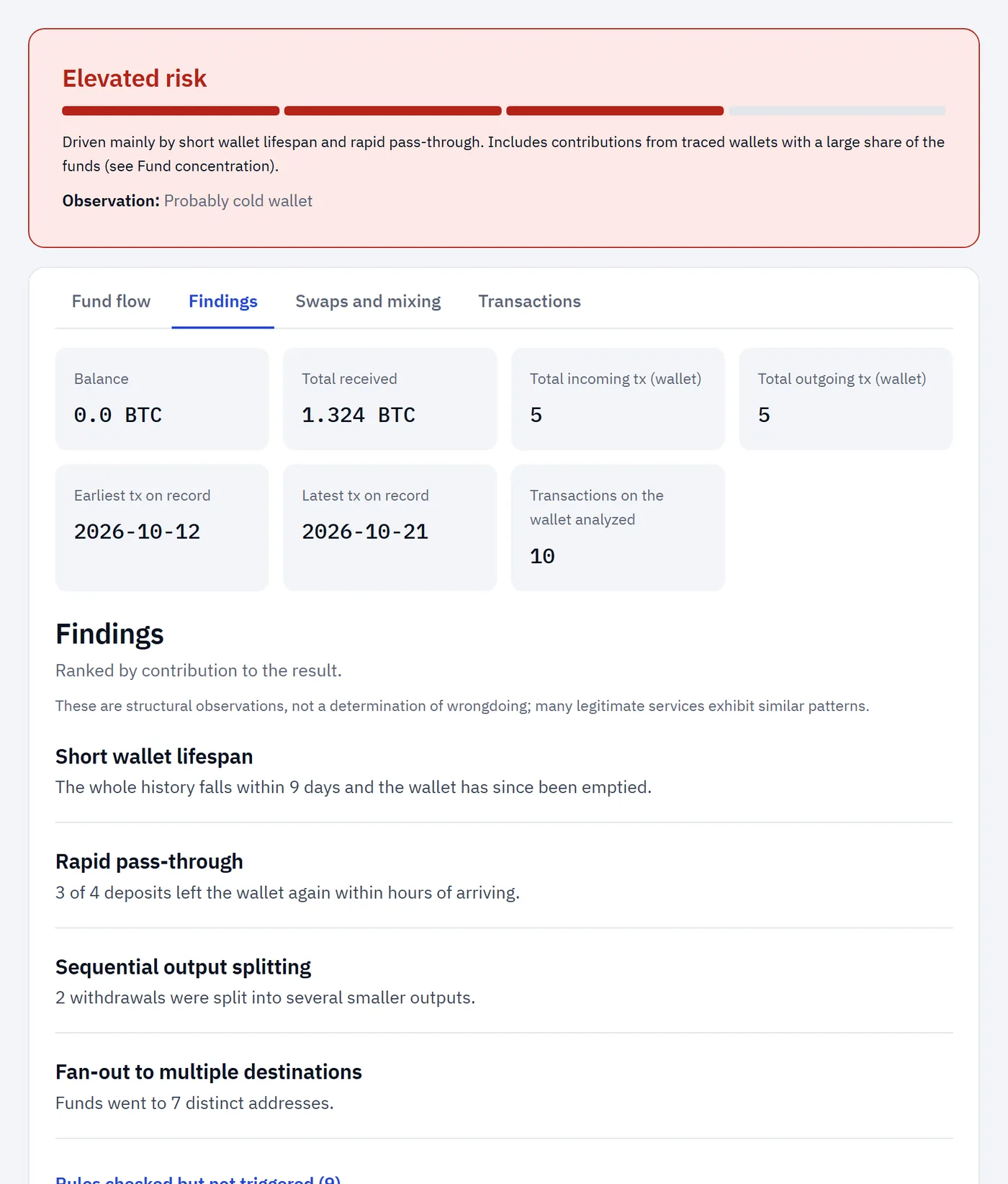
Each wallet receives one of four risk levels: low, moderate, elevated or high. The result names the behaviour patterns observed in its history, what exactly was seen and which mattered most, so an analyst can explain the outcome to a reviewer, an auditor or a regulator.
Before each run you choose what the assessment covers: where the funds went, where they came from, or both. The wallets traced along the way are assessed too and count towards the result.
Follow the money
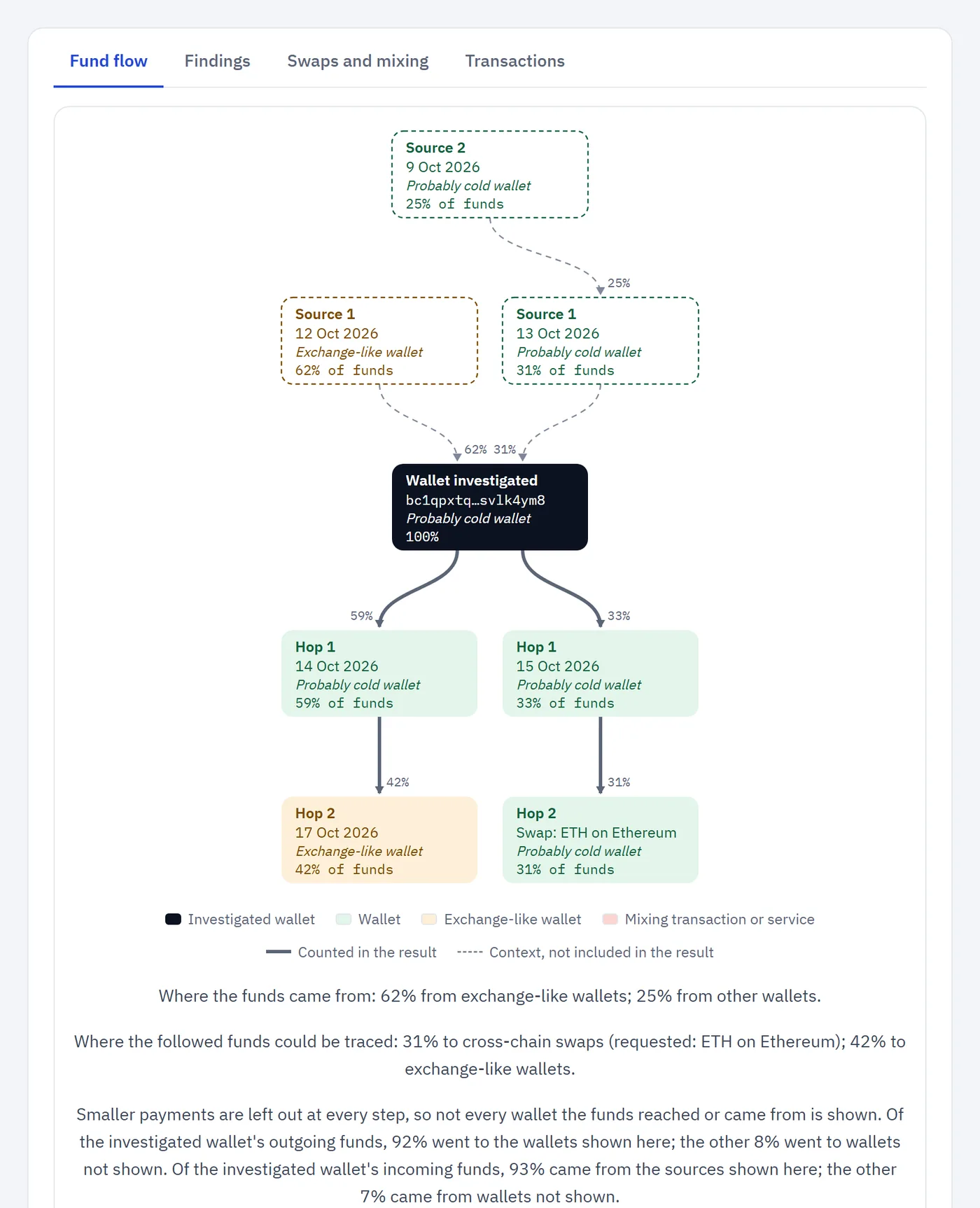
Tracing follows the larger flows hop by hop, forward to where the funds went and back to where they came from. Each wallet shows its share of the funds and when the money moved, and paths that converge meet in one wallet instead of being drawn twice.
Wallets that behave like an exchange are recognised and end a branch, so you can see where the funds left the trail you can follow on the blockchain.
Where the trail leaves Bitcoin
Every traced wallet is compared with the OFAC sanctions list, held in a database run by SKD Intel - Fraud & Risk Consulting, so no address is sent anywhere for it. A listing is shown as what the list states.
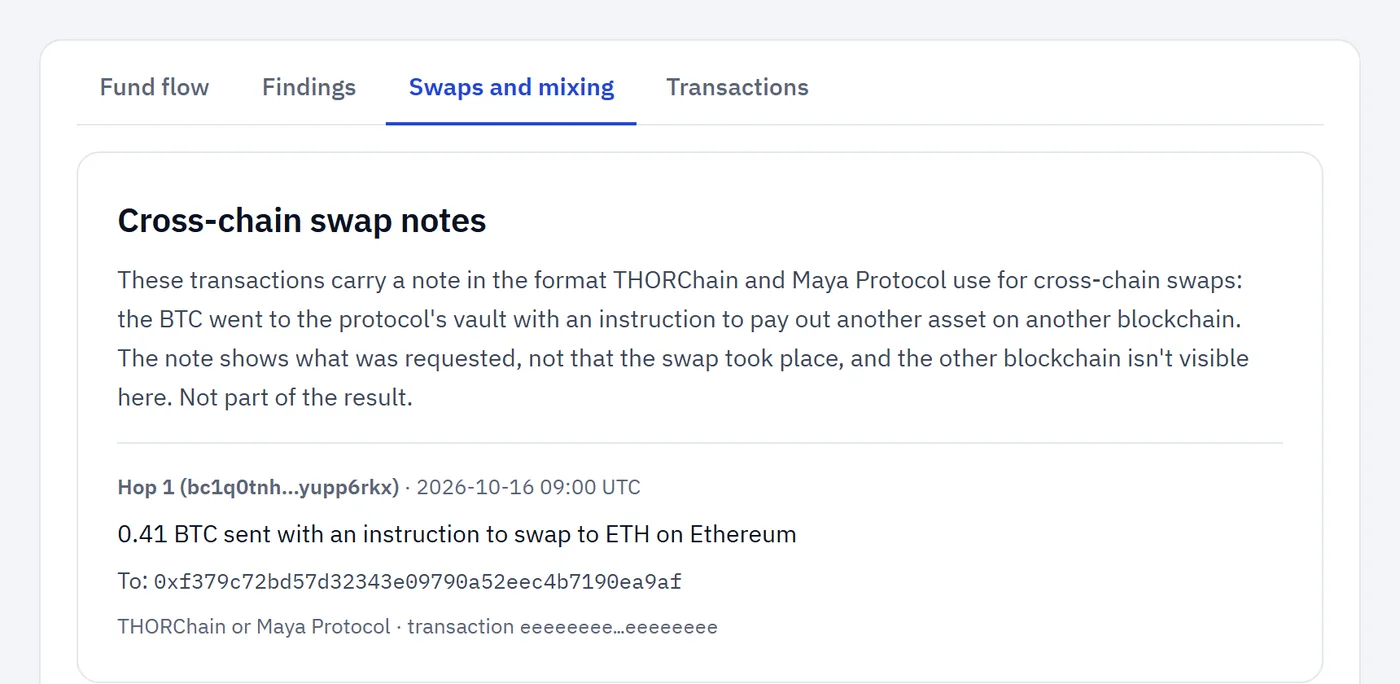
Cross-chain swap instructions (THORChain, Maya Protocol) show which asset the funds were heading for and to which address. Mixing transactions (CoinJoin) are recognised and named, and the trace ends there.
Reports ready for review
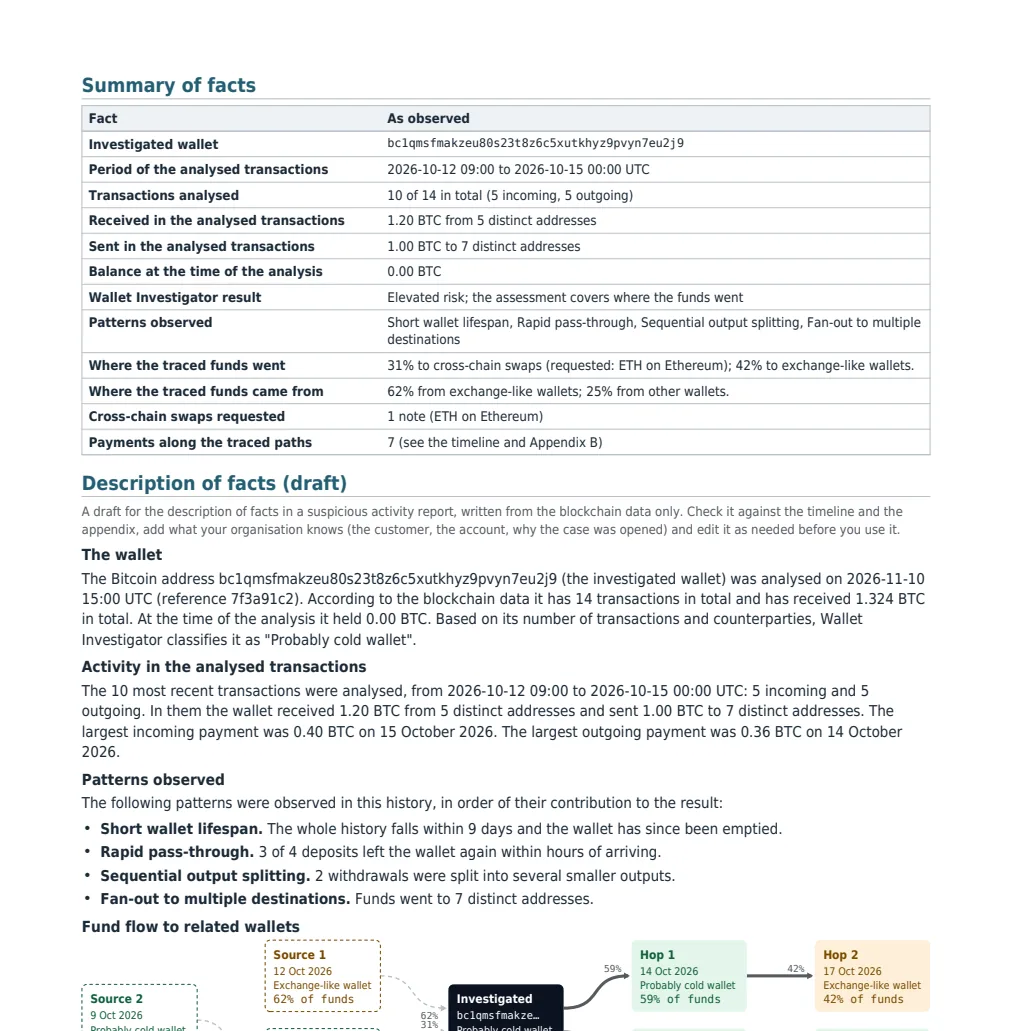
Export a PDF report for the file, or a Case Report built for escalation: a summary of the facts, a draft description of what was observed, a timeline of the payments, and appendices with every address and transaction ID.
The wording is strictly factual and carries no judgement. Whether to report, block or close stays with your team.
Also included
Watch a wallet
Get an email when a watched wallet moves. The alert names the wallet by the nickname you gave it, never the address, so nothing sensitive sits in an inbox.
Merge investigations
Combine up to five investigations into one graph to see the wallets they share, the flows that connect them and direct payments between them. A PDF is included.
Rules that fit your organisation
Run the default model or your own settings. Admins tune them to your customers and products, and every saved change is kept on record.
Who it is for
- Banks: Review customers who send funds to or receive them from crypto platforms.
- Payment service providers: Check the wallets behind payouts and refunds before you release them.
- Crypto businesses: Look into deposits and withdrawals that raise questions.
- Law firms: Document where a client lost funds went, for a claim or a complaint.
- Investigators: Start a case with a clear picture of the flows and a report you can hand over.
Built with privacy in mind
A Bitcoin node of its own
Lookups run on a Bitcoin node operated by SKD Intel - Fraud & Risk Consulting. The addresses you look up are not sent to an outside blockchain service.
Data minimisation
Only the minimum data needed for the investigation is used. It is deleted automatically after about three hours, and no copy of your reports is kept.
Access by invitation
Only approved organisations and email addresses can sign in.
Pilot programme
I am opening the Bitcoin Wallet Investigator to a small number of organisations before general release. Pilot organisations receive 200 free credits to run their own cases, a 30-minute walkthrough and direct access to me for questions. In return, I ask for honest feedback on what works and what is missing.
The pilot is open to banks, payment service providers, crypto businesses, law firms and professional investigators. Access stays by invitation: every organisation is approved before it can sign in.