Fraud Analytics
One report from your own transaction data: where your fraud sits, how it develops, and candidate rules with the fraud they would have caught and the genuine customers they would also stop.
From a transaction file to a fraud report
Knowing where fraud concentrates usually takes an analyst days of queries and pivot tables, and the rules that follow are often a guess.
Fraud Analytics turns your own file into one report and a set of candidate rules, each with its effect measured on your data before you put it into use.
Your data stays with you
Please use a file in which card numbers are encrypted or tokenised and names, email addresses and IP addresses are masked.
- 01
Choose your file
A CSV file of your transactions. It is read in your browser and never uploaded as a whole.
- 02
Map your columns
Say which columns hold the amount and the fraud label, and choose up to six attributes.
- 03
Anonymised before sending
Identifiers are replaced by meaningless numbers and dates are reduced to the month.
- 04
Your report
The analysis runs in memory and the report comes straight back to you. Nothing is stored.
See where your fraud concentrates
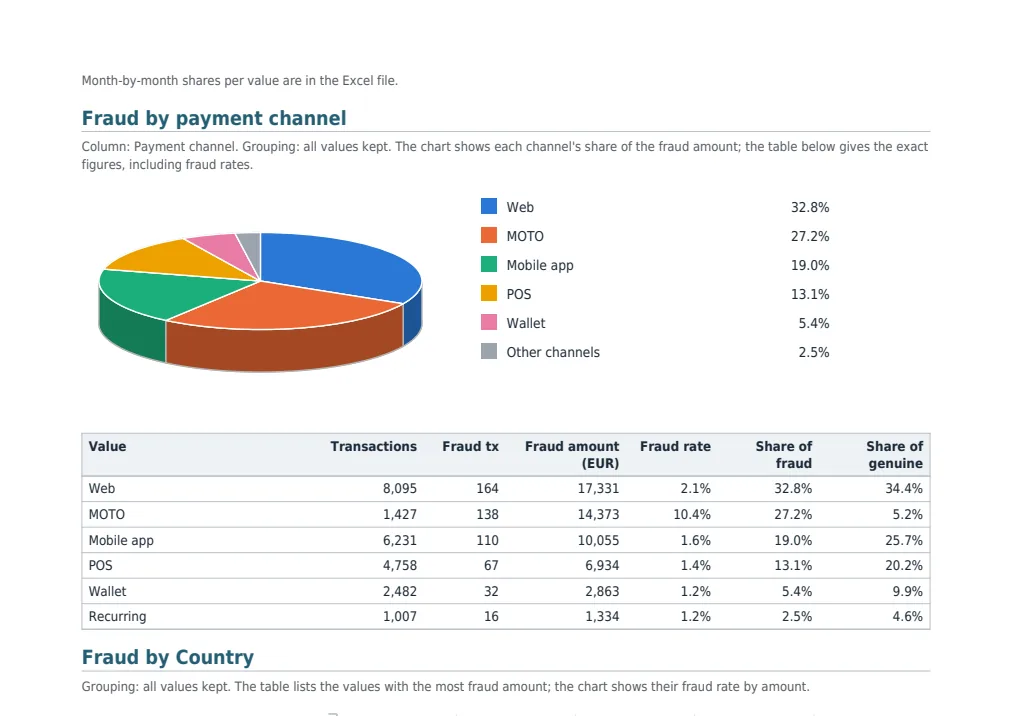
The report shows fraud by month and by each attribute you choose, for example country, card product, payment channel, amount or device age, so you see at once where fraud sits and how it develops over time.
Your browser can also calculate attributes from the file: how many transactions or how much money one card, email address or device moved in a time window you choose, in hours or days, before each transaction, and the time of the day.
Candidate rules you can test
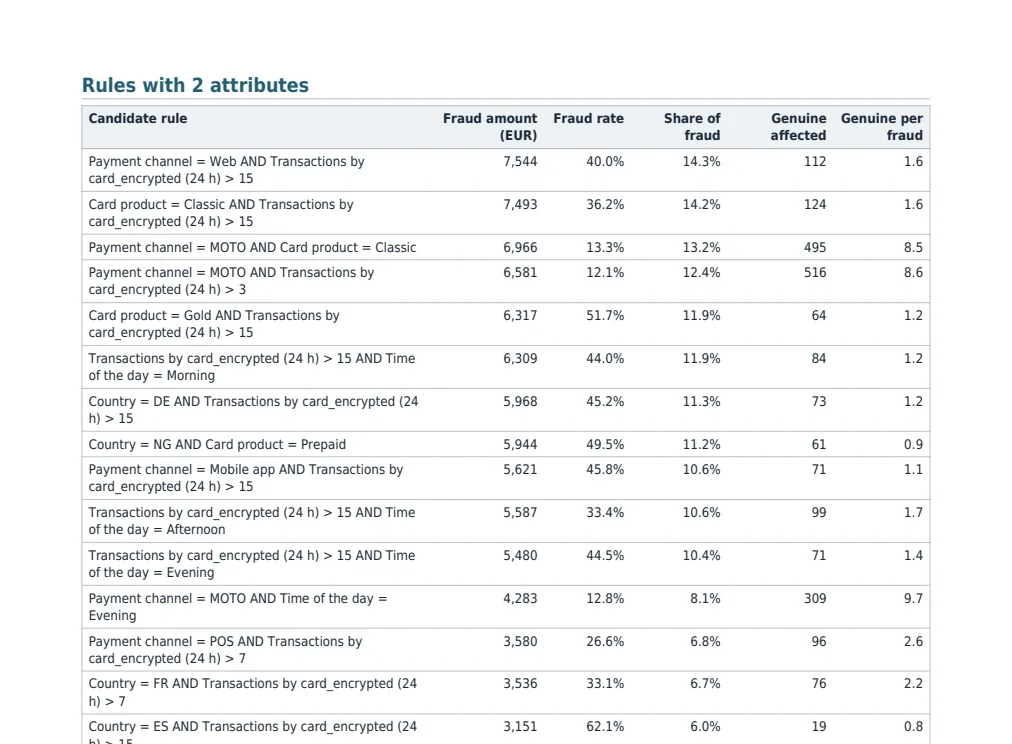
Combinations of your attributes where fraud is concentrated become candidate rules. Each shows the fraud it would have caught and the genuine transactions it would also have stopped, so you can weigh the gain against the friction for your customers.
Counters stay exact values, so a rule reads like a limit you can set in your own systems, for example more than 15 transactions on one card in 24 hours.
Who it is for
- Card issuers and banks: Find the segments where card fraud concentrates and test rules before you change your systems.
- Payment service providers: See which merchants, channels and countries carry your fraud.
- Merchants and online shops: Understand which orders turn into fraud and chargebacks.
- Crypto exchanges and fintechs: Review deposits, withdrawals and card payments with your own data.